Declining Fertility Rates and the Future of Healthcare Systems
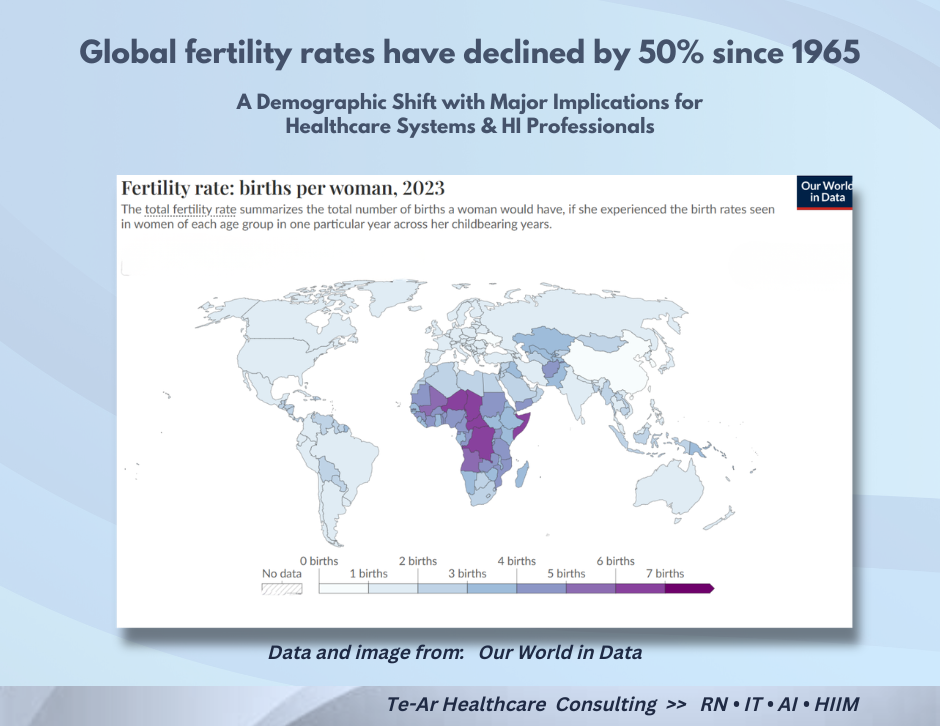
Declining fertility rates are not just demographic trends — they are reshaping healthcare systems, workforce dynamics, and global future care needs.
"Our World in Data" recently published research examining the global decline in fertility rates, with long-term implications for societies, countries, and individuals worldwide.
Birth rates are falling globally
The data shows that the global fertility rate — the average number of children born per woman — has fallen dramatically over the past sixty years. Historically, women had an average of about five children throughout much of the world. Since the mid-1960s, the global fertility rate has dropped by half, to fewer than 2.5 children per woman today.
Three major reasons for the decline (per the study):
- The empowerment of women — including increased access to education, contraception, and labor market participation
- Declining rates of child mortality and higher standards of living
- Rising costs of raising children — more children mean higher cost to families, and the decline of child labor reduces income for families
What this means for health systems
- Fewer births combined with an aging population will require significant restructuring of healthcare systems
- Demand for maternal and pediatric services may decrease for some populations
- An aging population brings increasing growth in chronic diseases and geriatric care needs
- An aging population will require more elder care
- Longer patient lifecycles will generate increasingly complex longitudinal health records and data needs
Are health systems structured for this shift?
With an aging population and fewer new generations to care for it, will this create a crisis for healthcare — or will AI be a welcomed and meaningful solution? AI may become an important support tool for increasingly strained health systems through predictive analytics, workflow automation, clinical decision support, and longitudinal population health management.
Where health information systems and HI professionals become essential:
- Interoperability across care settings becomes imperative (FHIR, HL7)
- Secure and effective health data sharing is non-negotiable
- Longitudinal health data management across the lifespan
- Predictive analytics for aging populations becomes essential
Where do you fit in — with your career, your lifestyle, your family? Declining fertility rates are not just demographic trends — they are reshaping healthcare systems, workforce dynamics, and global future care needs.
Data and image from Our World in Data, The global decline of the fertility rate.
Related reading: Nursing Left Out: How a Federal Definition Change Could Impact the Workforce