What is a Clinical Data Analyst?
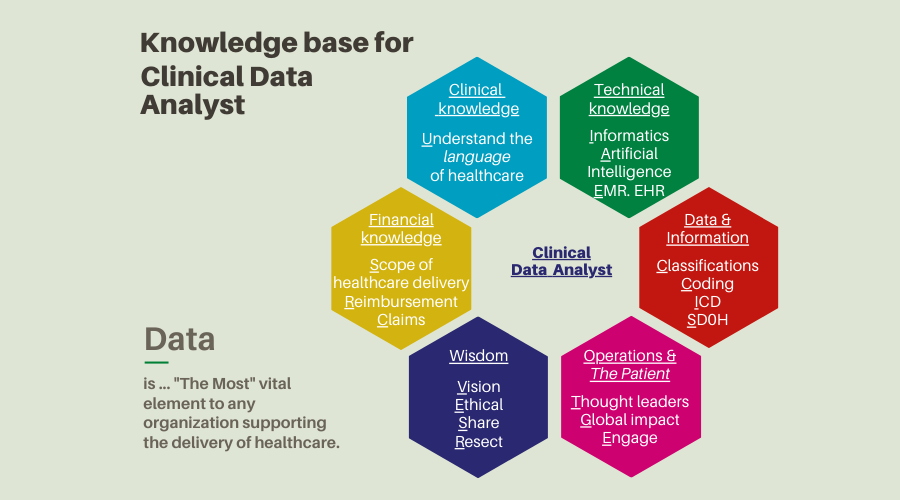
A Clinical Data Analyst is a healthcare professional with broad clinical and technical knowledge including the administrative, revenue, clinical, and claim payment functions. Along with these insights, a Clinical Data Analyst has a thorough understanding of the ancillaries, pharmaceuticals, medical research, and mobile technology integrated within healthcare. With this knowledge, a Clinical Data Analyst brings value to multiple domains within healthcare — benefiting medical practices and hospital providers, payers, and patients, as well as systems management, academia, and scientific investigation.
The value a Clinical Data Analyst brings to healthcare
A Clinical Data Analyst recognizes the value of data — a key factor that drives decisions within a healthcare organization. Some healthcare leaders describe data as "the new oil," an analogy to the value of oil for modern living and conveniences. With knowledge of healthcare data, a Clinical Data Analyst is integral to the process of collecting, cleaning, and storing data for use throughout the continuum of healthcare delivery, including data warehouse management, data reporting and visualization, claim analysis, and — most critical to all health organizations — the electronic health record (EHR).
Using data analytic skills, a Clinical Data Analyst adds value to an organization by making recommendations, contributing to decision outcomes, providing solutions, and often serving as a "strategic partner" to IT and business functions. From the purchase of equipment and devices to the delivery of healthcare and claim payment, a Clinical Data Analyst is highly valued for technical skills as well as individual attributes such as analytical thinking, problem solving, and simply liking to work with numbers and data — attributes that add to the longevity and reward of the career.
Data is the most vital element to any organization supporting the delivery of healthcare.
Scope of the Clinical Data Analyst role
Another attribute sometimes overlooked but highly valued for a Clinical Data Analyst is that of "technical liaison" or "clinical liaison." In this role, a Clinical Data Analyst is the subject matter expert bringing knowledge from the clinical, technical, informational, and financial domains to reach a common goal, as one would find on a special project. Speaking the language of medicine and technology, a Clinical Data Analyst can communicate the needs of each domain to integrate all aspects of healthcare.
Who fits the role of Clinical Data Analyst?
Professionals enter the Clinical Data Analyst role from a variety of backgrounds — technical, scientific, medical, or informational — and must then learn the other domains to contribute meaningfully to the organization's needs.
First, one must know medicine, health, and the delivery of healthcare. Knowledge of these factors across the continuum of care provides the basic competence to support and deliver value to a healthcare organization. Second, the individual must have operational and financial knowledge unique to healthcare — medical documentation and coding of medical events, revenue, quality, compliance, and standards of care provide the acumen to communicate data results and offer suggestions for improvement to stakeholders. Knowledge of industry standards and regulatory requirements, applied within the context of the Electronic Health Record, is vital to satisfy meaningful use, value-based care, and payment requirements.
Take-away
Data continues to grow universally, and within healthcare. The role of Clinical Data Analyst is valuable today and will continue to become more respected as data grows — especially digital data. The Health Information Management professional and Data Informationist are well positioned to succeed in this role.