U.S. Population Growth Slowing for Some States
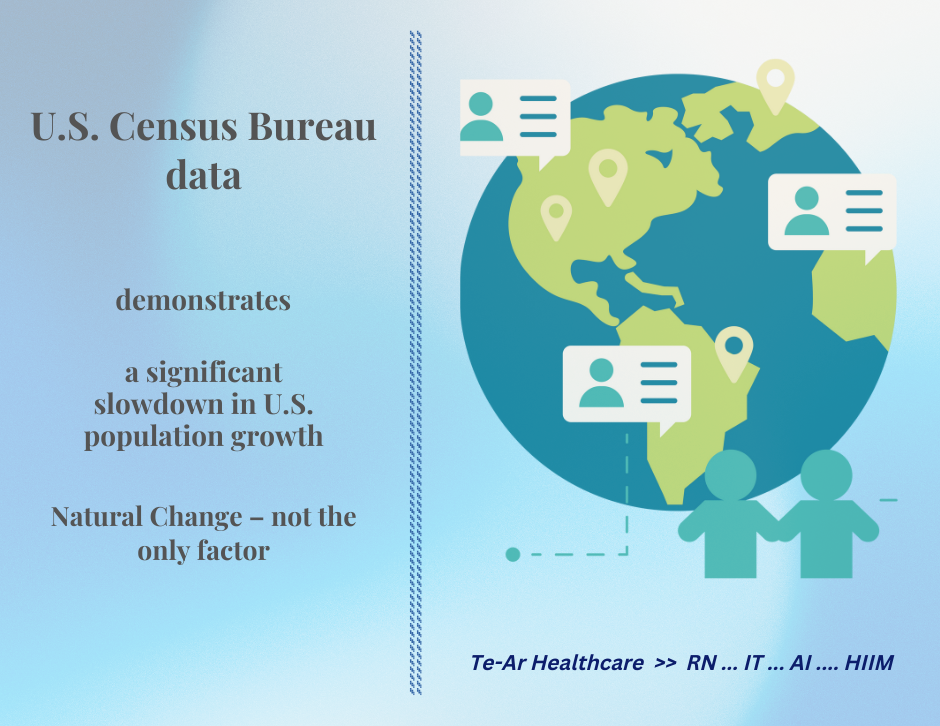
Shifts in migration patterns affect where healthcare services are most needed and require nurses and providers to adapt to more diverse cultural and language needs — a shift that will affect nurses and health information professionals both locally and globally.
Data from the U.S. Census Bureau
According to the U.S. Census Bureau's latest population estimates, U.S. population growth has slowed significantly. Between July 2024 and July 2025, net international migration (NIM) declined to about 1.3 million from a high of 2.7 million the previous year. Overall U.S. population growth slowed but did not reverse nationwide.
Natural change's shrinking role
Historically, U.S. population growth was driven largely by natural change — more births than deaths. As the Census notes, "with natural change less of a contributor to growth than it used to be, some states — especially those without positive net domestic migration — are dependent on international migration for their population to grow."
States with the highest population increases: South Carolina, North Carolina, Idaho, Delaware.
States with notable population declines: California, New York, Illinois.
Despite the overall slowdown, nearly all states experienced an increase in their immigrant population in 2024, underscoring how central international migration has become to population stability across the country.
Why the decline in 2025?
The current federal government administration's policies are viewed by many as the main reason. The sharp drop in net international migration between 2024 and 2025 raises important questions — many observers point to changes in federal immigration enforcement and policy, along with global instability and processing backlogs, as contributing factors. While the Census does not address causation, the policy implications are front and center in our daily lives.
Takeaway for healthcare professionals
The recent slowdown in U.S. population growth, driven largely by a sharp decline in net international migration, has important implications for the healthcare workforce and health data infrastructure. As many states increasingly rely on immigration to sustain population levels, nurses and health information management (HIM) professionals will be directly affected by shifting patient demographics, workforce availability, and care demands.
Changes in migration patterns affect where healthcare services are most needed and require nurses and providers to adapt to more diverse cultural and language needs. Stay informed, connected, and supportive — population trends are but one aspect of our rapidly changing career landscape.
Source: US Census Bureau, "Decreases in Net International Migration Slowed Population Growth Across the Country," published January 27, 2026. Written by George M. Hayward and Luke T. Rogers.