Is your AI playing offense or defense?
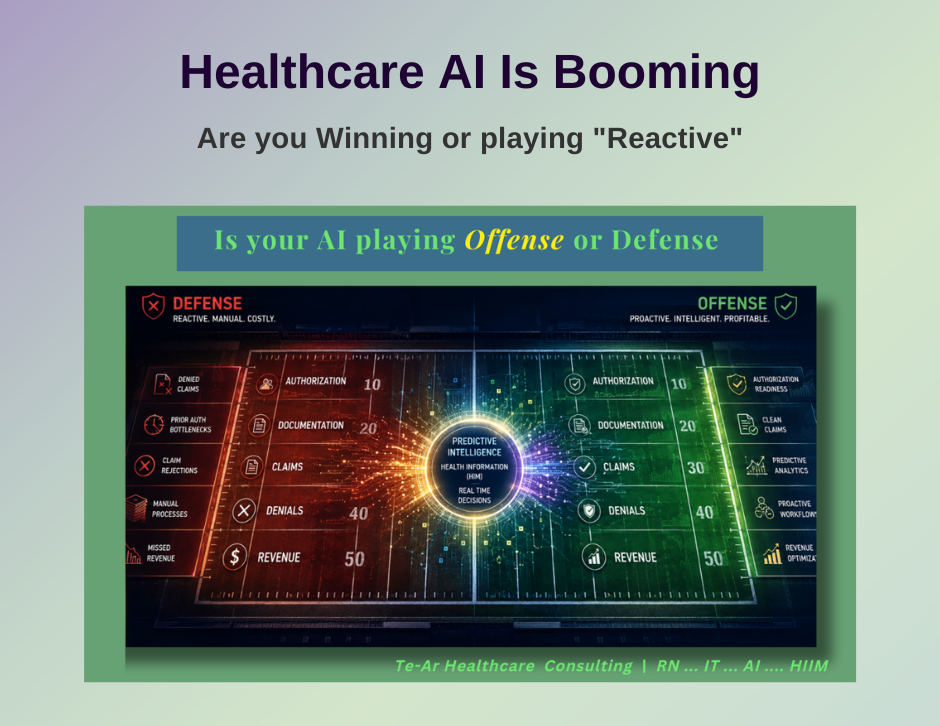
The Healthcare Operating Model for Revenue Cycle Management is shifting from recovering revenue to preventing revenue loss.
Most healthcare organizations are using AI defensively — applying technology after a claim has already been denied. While these tools have improved denial management and revenue recovery, they are still reacting to a problem that has already occurred. The next evolution of Revenue Cycle Management is offensive AI: using predictive analytics and intelligent automation before care is delivered to prevent denials from occurring in the first place.
Why change is needed
Prior authorizations were originally intended to ensure payment to the provider while letting the patient receive service without delay. A 2024 American Medical Association survey of 1,000 practicing physicians found that the average practice completes 40 prior authorization requests per physician per week, consuming 13 hours of physician and staff time. Ninety-five percent of those physicians reported that prior authorization delays patient care, and 94% said it contributes to burnout.
Current prior authorization model:
- A provider delivers care
- The service is coded and the claim is submitted
- The payer reviews and denies the claim
- The provider reacts — rework, appeal, and resubmit
- Repeat until one player ends the game
Although providers are using AI in the "rework" phase with real success, there is a limit to how far a purely retrospective model can go. Instead of recovering revenue after the fact, organizations are shifting attention to the start of service by applying AI-driven validation at the point of entry.
Transition to an AI revenue cycle model
- Identify authorization requirements before care is delivered
- Flag cases requiring prior authorization
- Submit documentation to the health plan and obtain approval
- Review documentation before claim submission
- A human intervenes as necessary to make final determinations
AI models can evaluate payer rules, historical denial patterns, authorization requirements, and documentation completeness before a claim is ever submitted. The value extends beyond reimbursement — proactive AI can reduce administrative burden, improve cash flow, decrease denial rates, and let clinical and revenue cycle staff focus on higher-value work.
Administrative benefits of predictive AI:
- Reduced administrative burden
- Improved patient experience
- Faster reimbursement
- Reduced accounts receivable
- Lower denial rates
- Less staff burnout
Is your AI playing offense or defense?
Yes, AI is transforming the healthcare environment and the career of the Health Information Professional. The future of Revenue Cycle Management is not simply faster denial management — it is denial prevention. Organizations that continue to focus exclusively on post-service recovery are using AI defensively. Organizations that leverage predictive analytics, authorization intelligence, and documentation validation before care is delivered are beginning to use AI offensively.
Human review, governance, and oversight remain essential. As AI becomes more deeply embedded in healthcare operations, the need for information governance, policy development, data quality management, and regulatory oversight will only increase.
Ultimately, the measure of success is not only fewer denials and improved revenue performance, but also whether providers gain meaningful time back for patient care and whether patients experience fewer delays in receiving medically necessary treatment.