From Retrospective Detection to Proactive Prevention in Medical Claims with AI
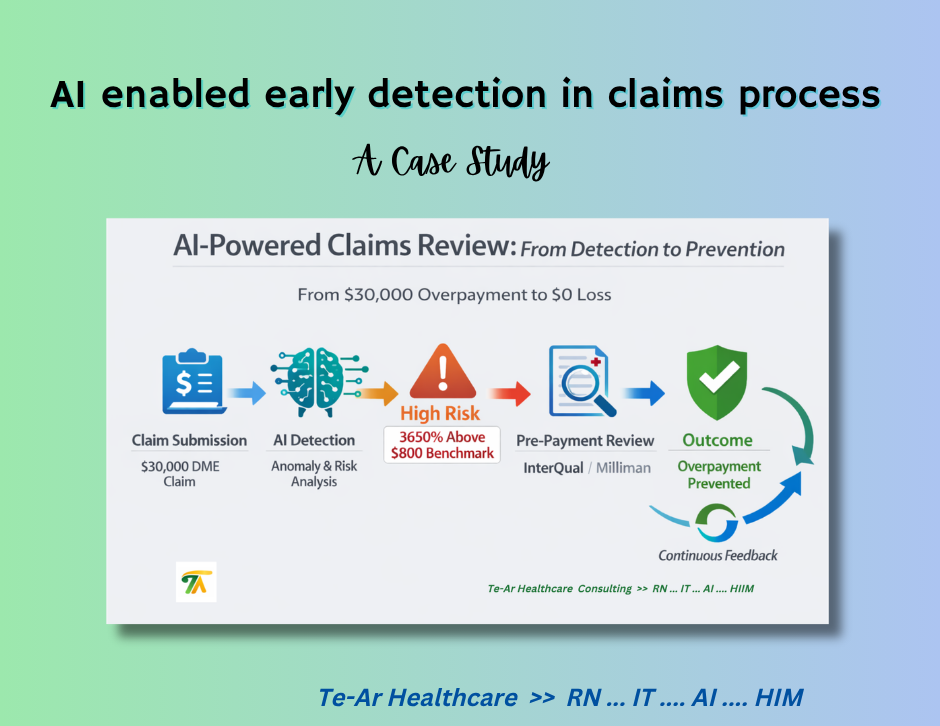
While AI enables the early detection of anomalous billing patterns, the effectiveness of such systems depends on the integration of clinical, coding, and contextual expertise. The Clinical Information Professional plays a critical role in ensuring these conditions are met.
Introduction
A claims review identified a provider billing $30,000 for a DME leg brace, significantly exceeding the expected Medicare benchmark of $800. A retrospective manual analysis revealed repeated overbilling across multiple claims over several years, resulting in substantial overpayments.
While some system checks have existed in healthcare payment models for years, the process often relies on manual (human) intervention — which is where the potential for errors occurs. In an AI-enabled environment, anomaly detection models could have flagged the claim at submission by identifying the extreme variance from expected reimbursement levels. Longitudinal pattern analysis would also have detected repeated high-cost billing behavior by the same provider, triggering pre-payment review and preventing financial loss.
This case highlights the transformative potential of AI in shifting healthcare claims oversight from reactive investigation to proactive prevention.
Case description (traditional workflow)
An insurance claims representative, working for a government-sponsored health plan, identified a claim submitted by a provider for a DME leg brace billed at $30,000. Initial review revealed that the Usual, Customary, and Reasonable (UCR) rate, based on Medicare reimbursement guidelines, was approximately $800.
Further investigation, querying claims data over a two-to-three-year period, revealed that the same provider had submitted multiple claims with the identical procedure code over several years, with similarly inflated charges — resulting in several thousand dollars of payment for this DME item and substantial financial loss to the payer.
The claims data analysis required a multidisciplinary skill set: a healthcare professional with clinical knowledge, medical coding proficiency, and the ability to query and analyze claims data using SQL. The findings were documented and escalated to appropriate governmental oversight bodies. While the analysis was ultimately successful, the process was time-intensive and occurred only after improper payments had already been made.
Key challenges identified
- Traditional models are reactive — relying on post-payment analysis to identify errors, overbilling, or fraud
- A manual review process is required, dependent on skillful visual examination — labor-intensive, prone to human error, and difficult to scale
- Limited data integration from fragmented systems, reducing the ability to detect anomalies at the point of submission
The role of AI in addressing these challenges
In contrast to a decades-long, manual claims review process, AI-driven approaches enable a more scalable and proactive framework for claims oversight. Machine learning–based anomaly detection models can evaluate claims in real time, combining item charge amount, allowed reimbursement rates, and historical payer data. An initial AI system can generate an immediate alert and pause a claim for review prior to payment, along with a risk score that routes the claim to the appropriate health information specialist.
AI moving to "the leader position":
- Machine learning with human-in-the-loop
- Learning from historical data that is continuously updated and current
- Integrating evidence-based clinical decision support — InterQual® Criteria and Milliman Care Guidelines (MCG)
- Supporting longitudinal pattern recognition across providers, services, and time
- Fair and anomalous detection
- Rapid response
Implications for Clinical Information Professionals
This is where the Clinical Information Professional (CIP) becomes central to the narrative. AI does not replace the clinical function — it depends on it. Rather than relying on time-intensive, retrospective reviews, CIPs are increasingly positioned to provide analytical oversight of AI-driven processes: validating flagged cases, interpreting risk scores, and applying clinical and coding expertise to support accurate adjudication.
As AI adoption expands, CIPs must develop greater data literacy and technical fluency — understanding how algorithms generate outputs, recognizing potential data quality issues or biases, and ensuring AI-supported decisions align with regulatory and reimbursement guidelines. Credentials such as the RHIT or RHIA, along with HIMSS certifications, provide foundational and advanced knowledge that supports effective engagement with AI-enabled systems.
The CIP with AI:
- Shift from manual review to analytical oversight of chart review, claims validation, and retrospective audits
- Expand competencies to include data models, training datasets, risk scores, anomaly flags, and data quality
- Take an enhanced role in compliance and ethical oversight, ensuring decisions align with regulatory requirements and audit trails
- Contribute to proactive risk management and fraud prevention by developing risk thresholds and review criteria
- Pursue continuous learning in AI governance, emerging reimbursement models, and regulatory requirements
AI does not replace clinical workflows or the Clinical Information Professional; instead, AI works in collaboration with them to improve the accuracy and timeliness of claims reimbursement.
Conclusion
Early detection of anomalous claims not only reduces financial loss but also strengthens compliance, governance, and program integrity. The increasing complexity and volume of healthcare claims demand more advanced methods of oversight. This case study illustrates how AI can transform claims review from a reactive, labor-intensive process into a proactive, data-driven function — enhancing fraud detection, reducing financial losses, and redefining the role of Health Information professionals.
This case study reflects a specific scenario and is intended for illustrative purposes. Findings may not be generalizable across all payers, providers, or claim environments.