Certified Health Data Analyst Certification has value for healthcare
Data is growing exponentially as the world becomes more technical, digital, and universally connected. The impact on healthcare continues to gain momentum and prominence as healthcare data becomes more numerical, with input from a myriad of sources, including wearables and devices. The Health Information Professional is not exempt from Big Data but rather is immersed in the analysis and interpretation of data across the healthcare spectrum. The expansion of data is both an opportunity and a challenge for the Health Information Professional.
To support the Health Information Professional through the world of Big Data, AHIMA created the Certified Health Data Analyst (CHDA) certification. With 10 years of data available, AHIMA undertook an in-depth analysis of test results to guide the workforce with best practices, offering insight into the reasons for the low pass rate and options to improve it.
CHDA pass-rate data (as of January 2023)
- The pass rate for first-time test takers declined from 26% in 2018 to just 10% in 2020 (later revised to 7%).
- The pass rate for first-time test takers rose to 14% in 2021.
- The pass rate for first-time test takers was reported at 50% for 2022.
Also noteworthy: 77 individuals sat for the CHDA exam in 2021, and only 38 in 2022. The pass rate improved substantially from 2021 to 2022, but the number of test-takers declined — the pass rate improved with fewer testers, which warrants its own analysis.
Highlights from the study:
- The pass rate has continued to decline overall (the 50% rate for 2022 appears to be an exception)
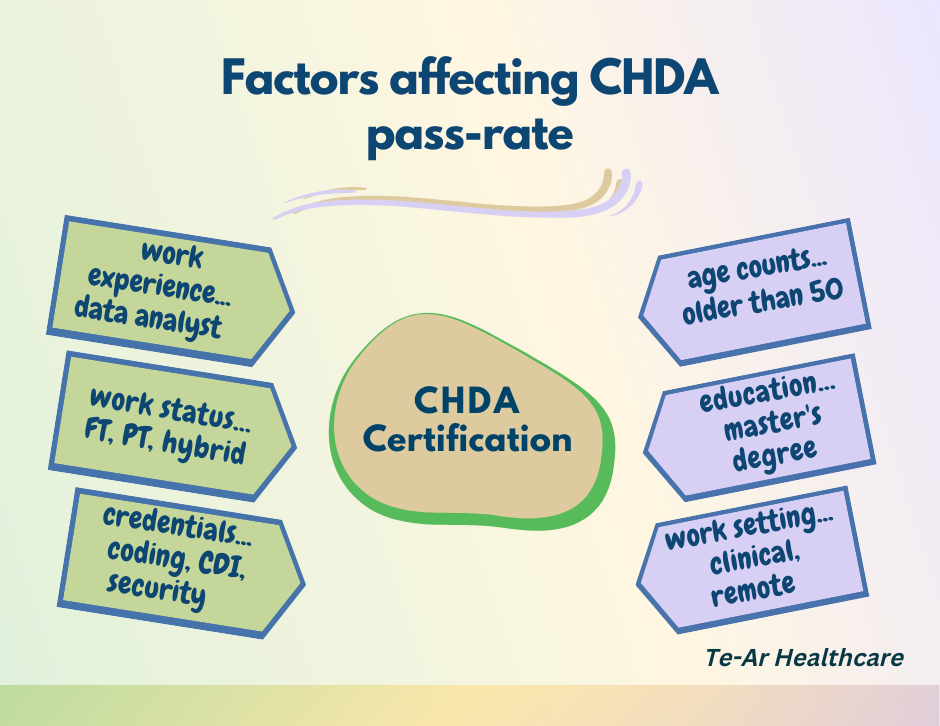
- Test-takers with a master's degree or higher are most likely to pass
- Test-takers aged 50 and above are more likely to pass
- Job setting is not (yet) a determining factor
- Other credentials (CCS, CCS-P, RHIT, RHIA) are not a factor in passing the CHDA, though the CCA credential decreased the likelihood of passing
Why pursue the CHDA?
CHDA is an advanced practice credential. First, a certification shows an individual's commitment to their profession — it demonstrates that one has invested time and resources to enhance their knowledge for a specialty or area of work. Second, the CHDA proves that a person has the technological and analytical expertise to perform healthcare analysis at the highest level, while maintaining the sensitivity and ethical standards that matter to the delivery of healthcare, patients, governance, and regulation. A certification also often correlates with a competitive advantage and an increase in salary.
How can we improve the CHDA pass rate?
Data will continue to impact the future of healthcare and the Health Information Professional's career — all reasons to continue supporting the CHDA certification. AHIMA must increase the number of credentialed CHDA holders to meaningfully impact the Health Information Professional's career in the healthcare workplace: 38 new CHDAs in one year is not sufficient to support the need for data analysts across healthcare.
AHIMA should devote resources to the success of the CHDA — bringing back onsite training (as was offered in Austin, TX in 2015), possibly a two-day class at the annual AHIMA Convention, mentors to help candidates prepare, written materials, study groups, and social media engagement showcasing the credential's value to the healthcare workplace.
This is an update to the article originally published February 24, 2022, "The Value of a Data Analytics Certification for Healthcare." Full article available at AHIMA.org, Perspectives, Fall 2021 edition.