Artificial Intelligence in Healthcare: Operational Impact for Health Information Professionals
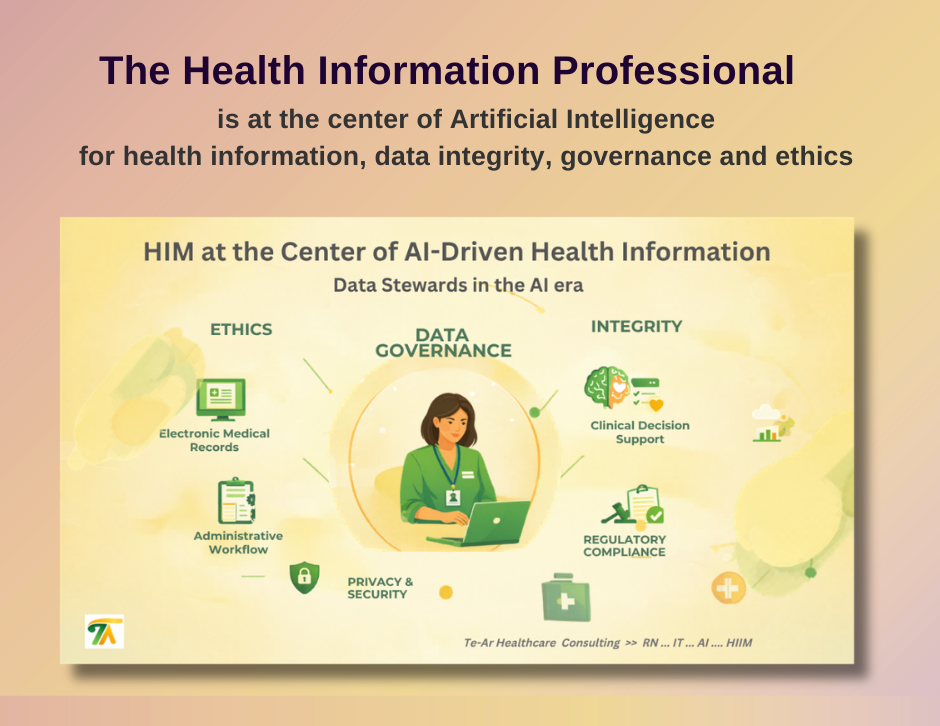
Artificial intelligence (AI) is no longer a conceptual innovation in healthcare — it is actively embedded in clinical and operational environments. What was once framed as a future disruptor is now a present-day force shaping how healthcare professionals diagnose, document, and deliver care.
How far have we come?
The acceleration of AI in healthcare is measurable: AI-related healthcare publications increased from 158 in 2014 to 731 in 2024, and the global AI healthcare market is projected to grow at a compound annual growth rate of roughly 47.6%, from $11.2 billion in 2023 to an estimated $427.5 billion by 2032.
Knowing these statistics, one might conclude the career of the healthcare professional has accelerated — however, increased adoption does not uniformly translate to improved efficiency across all clinical domains.
Is the healthcare professional operating more efficiently?
AI is beginning to deliver measurable improvements, particularly in workflow optimization and administrative burden, and its impact is most visible in areas closely aligned with HIM functions.
1. Clinical decision support and operational efficiency. The integration of AI enhances clinical decision-making while streamlining administrative processes. For HIM professionals, operational efficiency shows up in the daily demands of documentation review, coding accuracy, compliance oversight, and data quality management.
2. Automation of administrative workflows. AI applications now support automated EHR documentation capture, natural language processing for chart review, computer-assisted coding (CAC) for first-pass code assignment, and clinical documentation improvement (CDI) prioritization — allowing HIM professionals to shift from manual task execution to validation, auditing, and exception management.
3. Burnout and cognitive load. Administrative burden remains a significant contributor to burnout across healthcare roles, including HIM professionals managing high volumes of records and continuously changing coding requirements. AI-driven tools offer a meaningful intervention — not simply by increasing speed, but by reducing cognitive overload and preserving clinical focus.
Where do we go from here?
As AI becomes embedded across EHR systems, coding platforms, and operational infrastructure, two domains become critical: data governance and ethics.
Data governance — a core HIM responsibility. Effective AI implementation depends on a robust governance framework, an area where HIM professionals are uniquely positioned to lead: data quality and integrity, patient privacy and security, regulatory compliance, standardization of coding and documentation practices, and bias mitigation and equity. As AI becomes integrated into documentation and decision-making, the trust our healthcare model affords must extend to the data and systems that support it.
Ethical considerations. The integration of AI introduces complex, still-evolving ethical challenges: regulatory gaps (existing frameworks such as HIPAA were not designed for AI-driven data processing), documentation and coding risks (AI-assisted coding may introduce risk of upcoding or under-coding), bias and fairness (systems trained on incomplete or unrepresentative data may reinforce disparities), and accountability for AI-influenced coding and documentation decisions.
The role of the healthcare professional
In this evolving landscape, healthcare professionals are not passive users of AI — they are essential stewards of its application: data integrity, compliance, and ethical practice.
Critical to the HIM career:
- Maintain current knowledge of AI applications in healthcare
- Understand how AI tools are implemented within your organization
- Strengthen expertise in auditing, validation, and exception management
- Engage in professional organizations such as AHIMA and AAPC
- Pursue emerging AI-related certifications and education
The insight
Artificial intelligence is no longer a distant disruptor — it is a present and growing force in healthcare. AI is not a replacement for the healthcare professional but will function as a powerful partner now and for the future. Opportunities in healthcare are expanding as AI transforms the field, but with these opportunities comes responsibility: each of us must actively engage in learning about both the benefits and limitations of AI, so we can apply it ethically, effectively, and confidently in our professional practice.
Case study in practice: preventing overbilling with AI
In a recent review, a provider submitted a claim for a leg brace billed at $30,000 — far exceeding the Medicare benchmark of $800. Analysis of historical data revealed repeated submissions of the same procedure code over several years, resulting in thousands of dollars of overpayments before discovery.
Traditionally, investigating such claims required a manual process: benchmarking, historical claim queries, pattern identification, and formal escalation — effective, but delayed intervention and cost staff hours while allowing financial loss to occur. In an AI-enabled workflow, real-time anomaly detection and automated benchmarking could flag such high-risk claims before payment, with machine learning models recognizing repeated billing patterns and generating risk scores to prioritize expert review. The Clinical Informationist plays a pivotal role in this workflow, ensuring data integrity, validating flagged anomalies, and translating AI outputs into actionable decisions.
Data statistics retrieved from: "The Impact of Artificial Intelligence on Healthcare: A Comprehensive Review of Advancements in Diagnostics, Treatment, and Operational Efficiency," PubMed Central, January 5, 2025.